Pad Form Hang Tabs and Their Advantages

Hang Tabs are usually clear pieces of plastic with a hanging hole at the top and an adhesive section on the bottom. The hanging hole is usually one of four popular shapes; Euro Slot, Delta Slot, Round Hole or a Hook.

Hang Tabs are a quick and efficient way to add a hanging option to products.  Products in need of hang tabs include those where a hanging hole is not already in the packaging , where a hanging hole cannot be incorporated into the packaging (a common example might be a box of Condoms) or when the product does have a hanging hole but that hole needs to be repaired or reinforced.

Hang Tabs or self-adhesive hooks are most often supplied in sheet form and in roll form.  In the sheet format there may be anywhere from 4 Hang tabs to 20 hang tabs supplied on a sheet of backing paper. Then many sheets are packed into a bag or a box.  Sheet form is really the most basic format of hang tabs supply and is often the cheapest format.  Hang Tabs are often also supplied in Roll form.  The roll format is useful when using a mechanical or electrical applicator in very high volume applications.  In any other type of application the roll format sticky hook can be a clumsy format to use in a store or production line; it may be the only format available from some smaller hang tabs suppliers.

A third format of Hang Tabs is the Pad form hang tab.  This clever format of Hang Tabs involves a “stack” of 5 to 10 pieces of Hang Tabs one on top of the other.  The Top hang tabs is peeled off the stack and applied to the product. The hang Tab below becomes the next Hang Tab to be peeled off and applied; repeated until the bottom/last hang tabs is peeled off a common backing paper.  This Pad format hang tab probably inspired the brand name “scotchpad”.   Hang Tabs are sometimes referred to as do its associated to the products development by a company called Do-It.  There are “Do-its” that are also Pad format.

The pad format allows for easy staff distribution and is a very useful format when shop floor staff needs to repair hanging products or look for innovative ways to lift the visibility of products by taking them to eye level using sticky hooks and perhaps Hang Strips.  It is quite possible to comfortably carry 200 hang tabs on your pocket –something not very practical when considering the sheet or the roll form options.

In very high volume Pad Form hang tabs can work out to be the most cost competitive format as the amount of backing paper for the hang tabs is shared by the “Stack”. This can mean a PAD form hang tabs like the scotchpad range can have one piece of backing paper for 10 Hang Tabs.  In Sheet format or roll format EVERY hang tab has to have its own area of backing paper. Also the manufacturing process of the Pad format can lead to longer lasting expensive die cutting moulds and this can be passed on to clients.

The pad format hang tabs is usually a “flexible hang tab”.  A Flexible hang tabs has a rigid PET hanging hole section and a flexible lower sticky section.  It is commonly know that when comparing the same size rigid hang tabs with the flexible hang tabs the maximum holding weights and endurance for holding weights is less for a flexible hang tabs (perhaps 25% less than a rigid hang tab).  Making up for this loss in holding power is the Flexible Hang Tabs ability to fold down for packing.  For example, a manufacturer adding the option of hanging their product using a flexible Euro Slot hang tab may not need to change their shipping cartons at all – given his products can be have the hang tab fold over the top of the product as it is put into the original shippers used in their packaging operation.
The Poor Man’s Tamper Proof Seal – Pressure Sensitive Cap Sealing

It is an excellent approach to first understand the main purposes of applying tamper evident seals and induction seals to bottles and jars prior to choosing which one to utilize in your application.

For induction sealing the key benefits from that type of seal include:

a)    An evident proof to show the end user that the contents of the merchandise were not opened.

b)    It work as oxygen and moisture shield to preserve the reliability and shelf-life of the goods. For this reason alone, inductions seals are known to be freshness seals.

c)    Removes leakage out of caps. Plastic caps are often closed pretty tightly right after their bottles are filled. Caps loosening and leaking goods are direct results of temperature modifications and vibration while in transport,  frequently compromising considerable parts of product shipment that become hard to retail if not impossible.

d)    To present the product in a professional manner that show the manufacturers’ concern on the best practices of good product selling.

For pressure sensitive sealing – sometimes called PS22 Wadding the primary advantages of that form of seal are diminished:

a)    A visible tamper evident barrier indicating to the buyer the contents of this product have not been compromised.

d)    To provide a professional finish that appears similar to the amount of care used by manufacturers using induction sealing.

You’ll be able to carefully peel the liner off the neck of the bottle containing pressure sensitive wadding and merely tighten up the cap by making use of pressure to be able to reseal the bottle with virtually no equipment or tools needed. By doing this bottle sealing with pressure sensitive cap sealing is a bit more visual than practical.

Pressure sensitive cap lining material normally has no foil barrier and thus has little to no barrier qualities to prolong shelf life or keep freshness. Several liquid products are not fitted to PS22 cap sealing because it is glue based.

Why is it that businesses choose pressure sensitive sealing materials over induction foil sealing? In some cases it is lack of knowledge of the induction sealing process and in other cases it is the “poor man’s” form of a tamper evident seal.

Another reason is the fact that Induction sealing tamper proof evidence requires induction sealing machine while pressure sensitive sealing requires no machinery whatsoever.

From USD$3500.00, you will find “safe” bench top induction machinery. Many hand-held induction machines, offer for sub, starts at USD$1000 and manufacturers of that level of equipment refuse to offer safety certifications or advise that they do not “yet” have the certification.

An induction machine is not like a toaster or a kettle so watch out for anybody offering toaster or kettle price tags for induction sealing equipment. An induction machine works with high currents and produces high degrees of magnetic and electrical fields.

Bear in mind on some retail products within your shelf with pressure sensitive seal – that although it looks tamper resistant, it is merely ‘tamper evident’ at best. The company making that product is getting the lowest cost path to providing you with an appearance which resembles but in no way works like an induction seal or a tamper proof seal.

Induction Sealing Bottles Using Specialty Caps

On cases where the foil sits further than 4mm from the cap’s top surface, tunnel induction sealing head will allow you to seal it. Usually, this is the scenario with twist top spouts, flip top lids, sports drink caps, sipper caps or shaker caps.

When a coil shaped elongated coil generates high, rotating magnetic field, induction sealing occurs. The coil that carries a magnetic field is generated as well as, shift course several thousand times a second.

This magnetic field can pass through plastic or air. If it comes across metal, then it will work on producing current in the metal parallel to the coils that made the magnetic field.

A magnetic field produced from a “point” dissipates with the cube of its distance from that point. Generally, the magnetic field of an induction sealing machine ought to be within 5mm or ¼ inch from the sealing foil to have significant production speeds.

A number of cap variety do not match the standard flat top profile which presents a challenge to bring the magnetic field of the heat sealing equipment to within 5mm or ¼ inch from the sealing foil.

These types of specialty caps require an adaption from your standard flat coil sealing head to a tunnel sealing head. The Coils are designed to pass within the tunnel. The tunnel permits the protruding feature of the specialty caps to pass through the machine without moving the plane of the magnetic field farther away from the sealing foil within the bottle cap.

On the SealerOn webpage there is a youtube icon that will link you to videos showing SealerOn™ heat sealing or more accurately induction heat sealing using a tunnel sealing head.

Relying on the combination of cap and foil, the SealerOn™500 with a sealing tunnel installation has a speed capable of up to 10 meters per minute or 30 feet per minute.

The MeRo adjustable tunnel sealing machines are designed for faster induction sealing. These machines have the added and unique feature of having an adjustable width sealing head. This feature allows for higher concentrating and focussing of the induction field for increased sealing speed. A MeRo 2Kw unit is capable of sealing at sealing speed up to 30 Meters per Minute or 90 feet per minute depending on the cap and foil combination.

Less time required beneath the sealing head defines efficient cap sealing, which lead to higher production speed.

Flat profile sealing head allow an increased variety of cap sizes and permits the sealing head to be positioned at an angle over the product’s route to receive a sealing of cap diameters which are even wider than the coil winding pattern within the sealing head. Potentially a flat profile sealing head can seal caps from 30mm to 110mm wide. Not being able to seal specialty caps and lower speed throughput are the trade-offs for the flexibility of this profile.

Process Validation for Induction Sealing

Because there are unseen factors that can significantly affect the sealing performance of an induction it is always recommended to have induction sealing process validation.

The sealing machine may be bumped on a small angle, a slight height adjustment might have been made, large bottle height variations, and conveyor speed variations can all significantly impact on the induction sealing results.

Visual Inspections Process Validation for Induction Sealing

Actually, this method can be the best method of all; especially when you have well-trained operators experienced in what induction foils look like when they have received the correct conditions for a good seal.

Some things to look for include:

  1. A Concentric heat pattern in the foil; if you hold the foil to a light source at the correct angle you should see a smaller circle where material has not been heat affected.  This means the seal has heated from the outside inwards in an even pattern; hence an even seal
  2. Overheating – there are a number of factors to show if there has been overheating including – visual discolouration of one or more layers of the induction foil, bubbling or creasing, a flattening of the bottle neck, melting of a backing resealing foam (if present)
  3. Uneven heat sealing; linked in some ways to a) above a foil can look well sealed but an uneven heat seal can result in areas of the seal being too firmly “welded” or very lightly welded an likely to “pop loose with a little pressure on the side walls of the bottle/container

Provided you have operators in each shift that are well trained in the above areas to look for then the “subjectivity” of a visual process validation is reduced and the validation will hold more merit.

2.0 Simple version – Linepatrolman™ Process Validation for Induction Sealing

If you have doubts that you will always operators trained or experienced enough to cover what is required for a reliable visual process of validation for induction sealing then there is the simple option of a Linepatrolman™ which has no more controls than a reset button.

This unit needs no programming and simply provides an integrated count of the energy seen by the testing cell passing down the same path as the products.

The Benefel web site has a good animation of the Linepatrolman

In this animation the count gets up to “50”.  If that reading worked for the last batch and was confirmed to be a good reading by a very thorough visual inspection (and some leak testing), operators would look to obtain similar readings in subsequent production runs of the same product.

A reason that many need an induction sealing measurement is because the energy transferred by an induction sealing machine to the foil of an induction seal within a cap is a time and position dependent process.  If for any reason the product passes through the induction machine at a different speed, the induction sealing result will be different.  To an operator a 10% change in the speed of a product conveyor may not be noticed.  To an operator a 1mm height adjustment of the sealing head may not be noticed or a 5 degree angle change in guide rails may be missed.  The induction sealing setting on the induction sealing machine may not have changed at all, yet the sealing results could have changed significantly!

The Line Patrolman™ is a unique process validation tool that will pick up variations in energy transfer in what may look like an identical set-up to the last time an induction machine was run.  This tool takes way the guess work on what energy is being transferred and provided operator confidence that the machine is set to the best it can be set.


Exactly What Shape Sealing Head is Ideal on an Induction Sealing Machine?

To be able to understand what shape sealing head is the most suitable on an induction machine, we should learn first, precisely how induction sealing occurs.

The sealing head is the portion of the machine that is put over the path of the product cap or lid. Inside the sealing head is typically long oval shaped coils of thick wire that deliver high current that alters direction many thousands of times a second. The coil that contains a magnetic field is generated and in addition, adjust course several thousand times a second. The magnetic field will get weaker as it progresses away from the coil that made it to begin with nonetheless it is able to travel through air and plastic. Coming across metal, it will act to produce current.

Heat sealing machines function a little different. It is waiting for a product with metal laminated foil in its cap. The magnetic field from the sealing head acts to generate current in the laminated foil and the laminated foil gets hot. There is a layer that is laminated to the foil that turns wet with the heat or melts. When the product has completely passed from under the sealing machine, the foil will begin to cool and the layer that became “wet” will set to bond the laminated foil across the opening of the product.

It can be understood from the above principle that bottle or product sealing with the utilization of induction machines will rely on the time the product is under the magnetic field and how close it becomes to the origins of the magnetic field.

There are two distinct shapes of sealing heads for cap sealers being Flat profile and Tunnel profile sealing heads.

The Flat profile sealing head is suitable for “Standard Flat Caps”. A “Flat Cap”, typically speaking, means a cap where the plane of the induction liner is at 4.0 mm of the plane of the Cap’s top surface.

Tunnel Profile sealing head is best for “Specialty Caps“. Typically, the Tunnel Induction Sealing Head permits cap sealing in which the foil is located far than 4mm from the top surface of the cap; this is regular with twist top spouts, flip top lids, sports drink caps, sipper caps or shaker caps.

The magnetic field concentrates to a place inside the tunnel profile because of the tunnel sealing head thus delivers stronger magnetic fields over a generally smaller width route for the products moving below. A Tunnel sealing head also makes it possible for the coils inside the sealing head to have a route lower than the top of the product caps. This end in delivering the foil inside specialty caps closer to the magnetic field. The disadvantages of employing tunnel profile sealing head is the constrained array of cap dimensions it can efficiently seal and that it is not effective with big caps. MeRo™ brand induction sealer, nonetheless, is the exclusion to this concept. MeRo™ can, typically, cater for a range of specialty caps with an adjustment of 30mm and can seal cap diameter between 30mm to 60mm.

Better production speed is achievable where there is efficient cap sealing – less time beneath the sealing head.

Flat profile sealing head permit a larger selection of cap sizes and permits the sealing head to be positioned at an angle over the product’s route to obtain a sealing of cap diameters which are even greater than the coil winding pattern within the sealing head. Possibly a flat profile sealing head can seal caps from 30mm to 110mm wide. Decreased speed throughput along with the inabiility to seal specialty caps are the cons of this profile sealing head on a heat sealing head.

Why are Hang Tabs Applied in Shops and Not by the Manufacturer?

In many developed countries, the main demand and sales for Hang Tabs is generated at the Point of Sale (POS).

These developed countries have most of their non-food products produced and packaged in lower cost areas such as Asia and in particular China.  Where manufacture takes place in the developed country there is the opportunity to supply Hang Tabs to these regional manufacturers.  These opportunities are quite rare as the Hang Tabs are usually applied by hand except in very large scale packaging operations where they may be applied using labelling machines.

Applying Hang Tabs by hand is a costly business and the trend for hang sales of goods manufactured in these countries is to insure the hang sell feature is built into the packaging.  In some instances it is difficult or even not possible to have a built in hang sell feature.  A good example of where a Hang Tab is necessary for hang sell is where goods are shrink-wrapped with a film of plastic and there must not be any holes in this plastic.

Nevertheless, most Hang Tabs sales are to the point of purchase.

Retail shops need to maximise their sales which can be very dependent on how they display their best selling items and items they wish to promote.  It can be costly for shops to hold on to stock for too long as it is capital tied up and even worse capital lost where goods have a shelf life.

Bringing goods up to the eye level of clients and providing more choice and variety within the confines of the retail space available is a key priority for the shopkeeper.  Hang sell of products is a key way to achieve better product visibility and higher density displays.  The tools of Hang sell are Hang Tabs, often referred to as display hooks or Do-Its or even Scotchpads and display strips also called hang strips.

The hang tabs consist of clear pieces of plastic which are partially backed with adhesive. The adhesive section sticks to the product to be displayed and the non-adhesive section with a hanging hole profile projects above the product.  The product having been converted to hang sell is now hung from pegs, rails or hang strips.

Another reason why the POS will need hang tabs is to repair hang sell items that have damaged.  Often cardboard products with a Hang Sell built into the cardboard can tear.  Another common problem is when hang sell holes are cut into packaging like lollies and the cut is not clean.  In these instances the hanging hole can be weekend or not even present.  Large supermarket chain stores will go through hundreds of thousands of hang tabs just to repair broken hang sell packets.

While many shops continue to use older or more traditional format Hang Tabs such as those supplied in rolls or in sheets there is a growing awareness of the Pad Format Hang Tabs.  While the Pad Format Hang Tabs may cost one or two cents more per Hang Tab the added convenience of this format should easily pay for itself.  Pad Format Hang Tabs enables shop staff to easily carry 200 Hang Tabs in their pocket at any time and as these Pad Format Hang Tabs have five to ten times less backing paper per Hang Tab they take up much less space.  Sheet form and roll form Hang Tabs can be stuffed into a pocket but the pocket needs to be fairly large pockets and there is a strong likelihood Hang Tabs will be lost or spoilt by coming off their backing while still in that jammed pocket.


Sanstrap Stretchbands for Fruits and Vegetable Growers

Sanstrap is a clever pallet strap with substantial flexible strength produced from eco friendly PE film. Simple application delivers superb pallet load stability within minimum time. Perfect to secure pallet loads of: cartons, drums, pails and rolls.

The introduction of this elastic stretchband in the past can be regarded as a form of emerging trend inside the product packaging market. By simply placing an elastic stretchband on the upper layer of a pallet, a high system stability is the outcome. Because of its straightforward application (rather than the use of adhesive tape, for instance) and without harming the product packaging – it is especially recommended for intra-company transportation.

Fruits and Vegetables

In the successful marketing of perishable goods like fruits and vegetables, fast transportation and distribution with minimum damage during shipment is very essential.  Crates and boxes are often used for storage and movement of goods.  Prior to the movement of goods, the pallets need to be secured to prevent high stacked pallets from falling or shifting during movement. Different methods can be applied:

  • Stretch wrap or adhesive tape both take time to apply and time to remove. Adhesive tape can damage the boxes and it is an unpleasant product to work with, noisy, sticky and sometimes sharp.  Stretch Wrap is time consuming and to apply it takes far longer and may require dedicated packing stations and equipment.
  • Sanstrap product is a pleasure to use and easy to apply. It is also very easy to remove. And it is a plastic that can be recycled.

Handling and Stowage Practices of Fruits and Vegetables Growers

While the shape and condition of trucks or vans are essential elements in fresh produce transportation, the actual loading and stowing techniques are relevant to damage and loss:

  • the best loading factor should be attained, which is the maximum load that could be transported economically under satisfactory technical conditions;
  • the dimensions and design of packages must provide sufficient degrees of venting of contents with the least wasted room, and the packages needs to be sufficiently strong to safeguard the contents;
  • loading and unloading need to be correctly monitored to avoid reckless handling of packages; loading aids like trolleys, roller conveyors, pallet or forklift trucks has to be employed where possible in order to lessen the handling of individual packages; the use of Sanstrap palletbands can be employed when loading and unloading stacks.
  • stowage has to be cautiously carried out to prevent collapse of the stow for the duration of transport; Sanstrap stretchbands provide easy access to the cargo.
  • packages must not be piled greater than maximum recommended by the producer, otherwise the lower tiers may possibly collapse under the weight.
  • packed produce has to be shielded from the weather all the time including in the course of loading and unloading;
  • If the load will be dispersed to a number of destinations, packages has to be loaded backwards to which they will likely be unloaded, i.e. last on, first off; concurrently, the load has to be distributed equally around the vehicle.


When is the Best Time to Buy a Self Adhesive Labelling System?

A number of business owners or flourishing companies are turning up on the retail and wholesale market having a good potential product that will land them a good market share and even create a brand new market. Many are broadening their selection or growing their output capacity.

Each one is confronted with the very same concern; when is it time or when is it warranted to invest funds on a label applicator. Let’s study the 4 probable payback areas for automating your label application in an effort to respond to this inquiry.

1.0    Production Throughput

An in-line pressure sensitive label applicator will typically pick up labelling speeds from under 15 pieces each minute to approximately around eighty goods per minute for many applications as compared to manual or semi-automatic labelling. Labelling may typically be automated at between thirty five and forty five pieces per minute for many round products that call for orientation. This will enable swift turnaround of medium and big orders, eliminating bottle neck in your premises.

2.0    Product Presentation – Consistent, Accurate Label Placement

When presenting your merchandise to the market, eliminating the common mistakes of labelling such as label creasing and also irregular label setting will make a big impact. First impressions count and if you have a new product completely ready for the market you must be conscious about how soon an initial impression is created by people based on the first couple of seconds of simply looking at the presentation. Start up companies can achieve automated labelling results by means of an automatic labelling system through contract manufacturers or hiring systems.

3.0    Automating your production – A Good First Step

Often, the first piece of in-line equipment invested in by a company to manufacture in house is the labeller. Modular systems with the flexibility to deal with numerous range of shapes without any or marginal change parts are the most effective systems. In-Line Labelling machines will normally have a conveyor of length 3.0 meters or less and can feed on to gathering tables or close to the end of a selection and packaging table where by operators remove, check out and package the finished goods.

4.0    Production Cost Savings – Installations can have payback periods of 6 months or less

One area of underestimating expenses for those starting out in business is the time and cost of manually putting on labels. Aside from the “costs” related to the first three considerations in the above list you can find considerable labour expenses to be saved. To be able to manually label a container or product in the western world, the real cost is anywhere between 3 cents to 20 cents per container. Pace in manual labelling can rarely be held; a speed of more than 15 labels per minute eventually ends up to six labels per minute – 1 in every ten seconds. In Asia, where manufacturing cost is lesser, this might work out to be 2 cents or less per label. In higher cost manufacturing bases like Australia, Europe, the USA or South Africa this labelling cost is more likely to rise towards 5 cents per label for every product. Do remember some products have 2 labels or even three labels.

Justifying the acquisition of a labelling system varies; several businesses can benefit in every 4 areas at once while some may benefit on just one of the above criteria. When taking into account a labelling system you should contemplate all four major reasons in the above list and how they might apply to your circumstances.

Whether or not to move to a more in depth machine proposal and eventually proceed through formal machine proposal, machine suppliers providing the Label-On™ modular system of labelling can quickly assist you.

LabelOn™ Basic Top and Bottom Label Applicator

You are Reading LabelOn™ Basic Top and Bottom Label Applicator which is a post from: LabelOn™ Labeling Machines If you have enjoyed this post, be sure to follow us on Twitter, Facebook, Google Plus

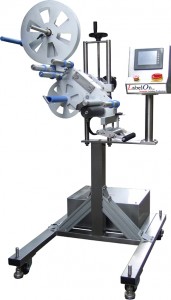
The LabelOn™ Basic Top and Bottom Label Applicator Range incorporate advanced, and sophisticated label dispensing system with user-friendly interface and easy to use adjustments.  Virtually maintenance free, they are easy to change label application height, thus saving valuable time and achieve higher production capacity.

The LabelOn™ Basic range has models that can label one or two panels of a flat bottom/top product from above and below. Also an Overhead Conveyor can be added to help stabilise the product during conveyor transfer.

LabelOn™ Basic Top and Bottom Label Applicator Picture

LabelOn™ 610 Front, Back and Wrap Labeler

LabelOn Al100 Stand Alone Labeler

LabelOn Al100 Stand Alone Labeler


Bottle Labeling Machine Overview

You are Reading Bottle Labeling Machine Overview which is a post from: LabelOn™ Labeling Machines If you have enjoyed this post, be sure to follow us on Twitter, Facebook, Google Plus

Bottle Labeling Machine and Bottle Labeling Equipment

A bottle labeling machine is often the first move toward medium to large volume production capacity. Many bottled consumer products start their journey in small kitchens or laboratories or even garages. As the brainchild of an entrepreneur who has something with a competitive edge or something to fill a gap in the market, the transition from a product they personally love to a product everybody loves involves a production and packaging journey.

This article focuses on the packaging journey where production constraints need to be overcome to be able to offer the product in volume. As a product begins its packaging journey, first impressions on the shelves of stores and in front of buyers can decide the longevity of that product, independent of how good the product really is for its intended real life application. The packaging has to be right and the look needs to be consistent. The bottle neck in production for many starting out is often the bottle labeling. Self-adhesive labels look great on the designers screen and on mock-up bottles; translating this concept and look onto thousands of bottles is a mind boggling task for those given the task of manual label application. The eye is incredibly accurate and picks up variations in label height, alignment, bubbles, creases and label misalignment or unwanted angles.
If you ever get to talk to an entrepreneur who began production of their product manually there will almost always be a less than fond recollection of the daunting task of applying the labels and just how painstaking that task in the production can be.

The cost of labeling a bottle without an automatic label applicator far exceeds the cost of the label in terms of the manual labor, the compromise in product uniformity and the reduced capacity to fulfill unexpected or urgent market expanding orders.
An industrial labeling system or label applicator can make a world of difference and represents an investment that could typically range between USD13,000 and USD80,000 depending on the versatility of equipment required and the complexity of the bottle shape and label(s) placement requirements. The LabelOn™ labeling systems have two ranges of bottle labeling machines, where the Basic range provides low end more dedicated equipment and the Modular range provides versatility to cover a wide variety of applications and quickly change between those applications.

The labeling equipment will usually consist of a product conveyor, label dispenser(s) and various measures to hold or guide the bottle during the labeling process. Typical lengths of machinery are 2.4 meters to 3.0 meters or 7 feet 10 inches to 9 feet 10 inches. The machines are often supplied with castors for rolling short distances on flat floors and the machines can be set to label empty bottles or full bottles.
If the bottle labeling machine is your first machine, LabelOn™ usually recommend you consider placing the machine in your production process to label the products empty. Empty bottles avoid the potential for spilled product on the machine. Labeling accuracy is all about how well a product and its label are controlled during the labeling process, so the cleaner the machine the more consistent you can expect your bottle to be labelled.